Can a Gym Send You to Collections? What an Unpaid Contract Really Adds Up To

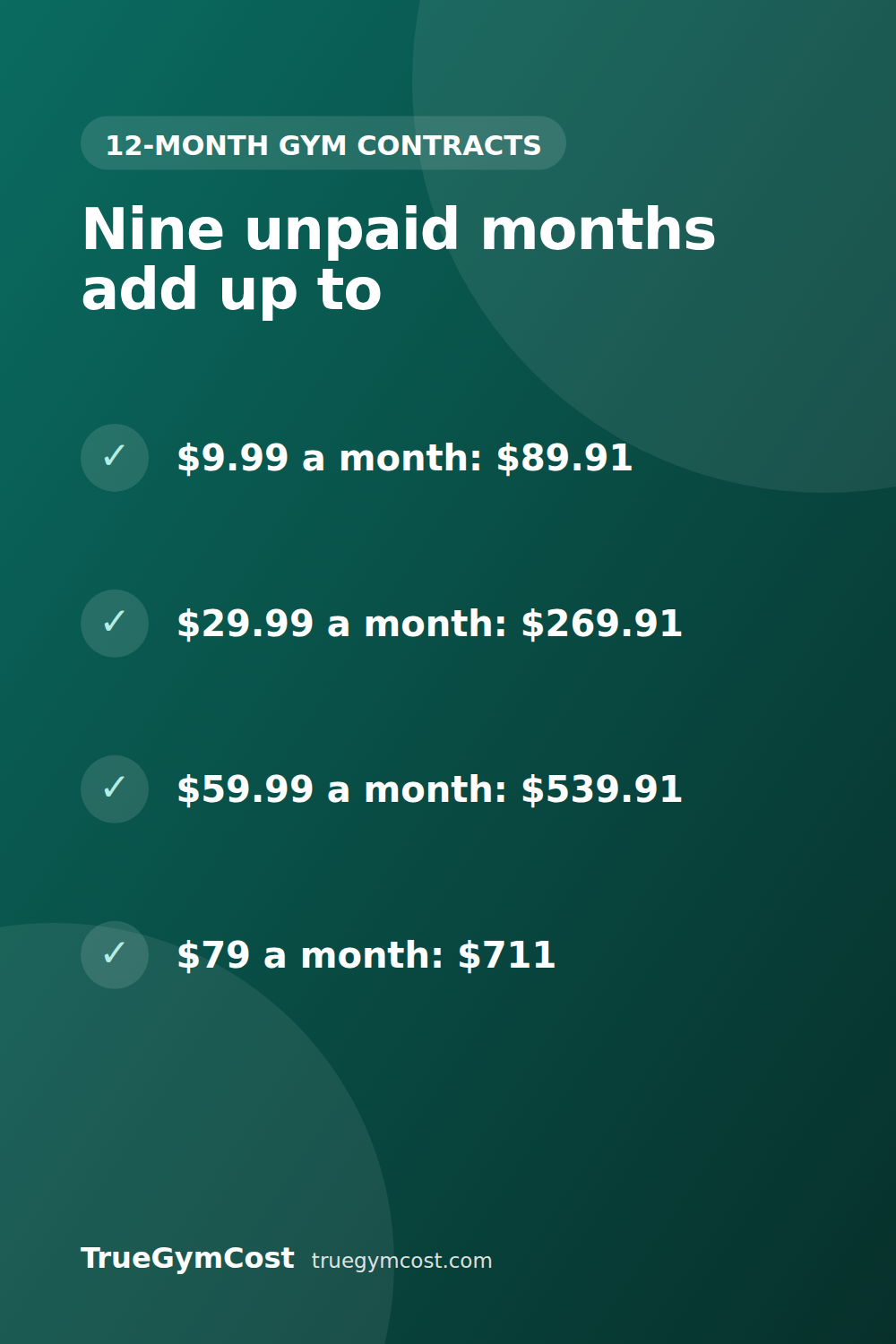
Yes. If you signed a gym contract and stopped paying, the gym can hand the unpaid balance to a collection agency, just as a phone company or a landlord can. That holds even if you stopped going months ago, and even if you thought you'd cancelled but didn't do it the way your contract asks. How much is at stake depends on what's left on the contract: on real San Antonio plans, nine unpaid months come to about $90 on a $9.99 plan and $711 on a $79 plan.
Most of this can be avoided, and if it's already happened you have more rights than it may feel like. This is general information, not legal advice. Your own contract and your state's law decide your case.
What happens if you don't pay your gym?
It usually starts small. The gym tries to reach you with calls, emails or letters about the missed payments. If that goes nowhere, it can pass the account to a collection agency, and from then on you'll be hearing from the agency instead of the front desk.
The trap people fall into is thinking that walking away ends it. A gym contract works more like a lease than a subscription: you've agreed to pay for a period of time, and not using the place doesn't change that. The same goes for a cancellation that wasn't done properly. If your contract asks for a letter and you told someone at the desk, the gym may still consider you a member, and the dues keep counting.
What an unpaid gym contract adds up to
Say you stop paying three months into a 12-month commitment, which leaves nine months on the contract. An annual fee may come due in that time, too. Gym prices move, and these are San Antonio's as of November 2026.
| 12-month plan, monthly dues | Nine months left | With a $59.99 annual fee |
|---|---|---|
| Crunch Fitness Base, $9.99 | $89.91 | $149.90 |
| Gold's Gym Commit & Save, $29.99 | $269.91 | $329.90 |
| Gold's Gym (Alamo Heights), $59.99 | $539.91 | $599.90 |
| 9Round (Louis Pasteur Dr), $79 | $711 | Not published |
Treat those as what's riding on the contract, not a bill you're sure to get. Some agreements charge the months that remain, and others use a buyout fee instead, so the number that counts is the one in your own copy. If you don't have it, ask the gym. The gym contract red flags guide shows what to look for.
A month-to-month plan is a much smaller risk. EōS Fitness's $29.99 Will Power plan in San Antonio, for example, is month to month with 30 days' notice to cancel, so forgetting to give notice costs about one more month. Life Time's $199 monthly membership has the same 30-day notice, which makes that one month a bigger number.
A collector can only add interest or fees if your contract or a law allows it. So when a balance arrives looking bigger than the dues you missed, it's fair to ask exactly how they got there.
Can a gym membership affect your credit?
Not by itself, in most cases. A missed gym payment usually only reaches your credit report once the debt has gone to a collector and that collector reports it to the credit bureaus. Not every collector does.
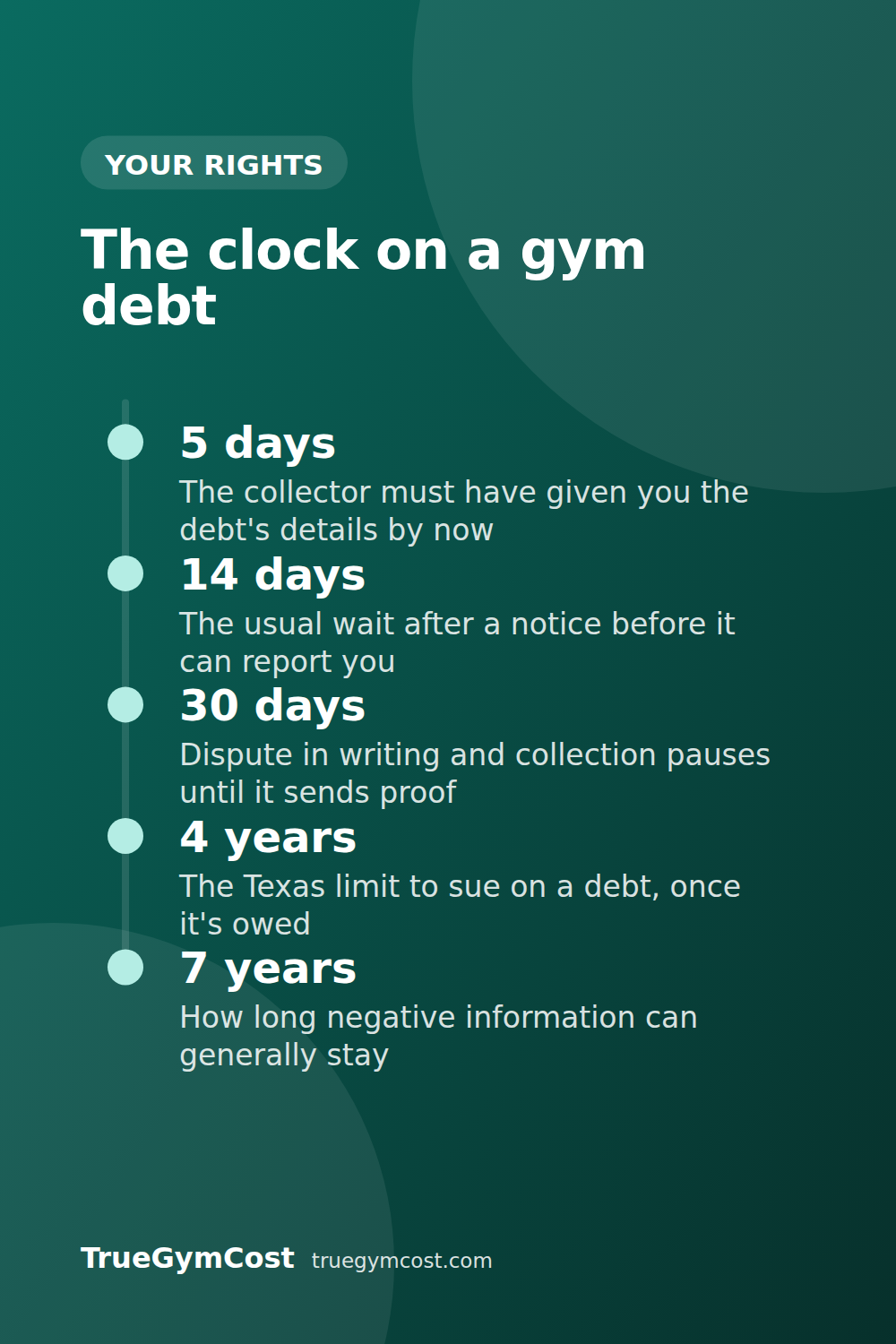
There's a step in between that protects you. Before a collector can report a debt, it has to either talk to you about it or send you a notice and wait a reasonable time, usually 14 days. A notice like that is your cue to check the balance and dispute it if it's wrong. If it does end up on your report, negative information can generally stay there for seven years.
What a collector has to tell you, and what it can't do
Federal law covers household debts like a gym membership once a debt collector is chasing them, and it gives you real tools. When a collector first contacts you, or within five days of that, it has to give you the details: who it is, who you owe, how much, how that amount breaks down, and what to do if you don't think it's yours.
From there, you have 30 days to dispute the debt in writing, and the collector has to stop collecting until it sends you written verification. If you don't dispute it, the collector can assume the debt is legitimate, which is why it pays to answer rather than ignore the letter.
A collector also can't call before 8 a.m. or after 9 p.m. unless you've agreed to it, and it can't call more than seven times in seven days about a particular debt, or again within seven days of talking to you about it. If a collector breaks the rules, you can report it to your state attorney general, the FTC and the Consumer Financial Protection Bureau. You also have one year to sue a collector that breaks the law, and a judge can award up to $1,000 even if you can't prove damages.
Can a gym sue you or take your wages?
It can sue, though for a balance of a few hundred dollars that often isn't worth the legal cost. Wages can only be garnished with a court order, which means a lawsuit has to come first.
If you're ever served with court papers, respond by the date they give, even if you think you don't owe it. Ignoring a lawsuit is how a small debt turns into a judgment against you.
How long can a gym come after you?
There's a time limit to sue, and it depends on the debt and your state. In Texas, a suit on a debt has to be brought within four years after the claim arises. Once the limit passes, a collector can't sue you over it.
Be careful around old debts, though. In some states, making a payment or acknowledging the debt in writing can restart the clock. Before you send anything on an old balance, find out where it stands.
Texas gym contract rules worth knowing
Texas regulates gym contracts under its health spa law, and a few of those rules are handy if you're trying to get out of one:
- Three business days to change your mind. Send written notice and proof of payment by certified mail to the gym's home office by midnight of the third business day after the contract date, and you get a full refund within 30 days.
- A contract can't run longer than three years, and a financed one can't require payments for more than five years after the contract date.
- You can cancel for a partial refund if the gym closes and offers nothing within 10 miles, moves more than 10 miles, or fails to provide the services it advertised.
- Death or total and permanent disability also lets you or your estate cancel for a refund of the unearned payments.
Those rules don't cover every place you can work out. Tax-exempt organizations, member-owned clubs and some others are outside them. Any way out beyond those refund rights depends on your contract.
What to do if a collector calls about a gym debt
- Don't pay on the first call. Ask for the written details the collector owes you.
- Pull out your contract and bank statements. Check the months, the fees and the date you cancelled.
- If it's wrong, dispute it in writing within 30 days. Send it a way that proves delivery and keep a copy.
- If it's right, try to settle. Get the deal in a signed letter before you pay anything.
- Keep every letter, receipt and note of each call, with the date.
How to stop it before it starts
Almost all of this comes down to one thing: cancelling in the way your contract names, and being able to prove you did. If it says in person or by letter, an email may not count. Keep a signed form, a confirmation email or a delivery receipt, with the date, then watch your statement for the next two billing dates. The full walk-through is in how to cancel a gym membership.
And before you sign the next one, run the whole sum. A gym's first-year cost is its monthly dues times 12, plus the joining fee and the annual fee, and a commitment means that total is what you've agreed to pay. The true cost guide lays that out.
Questions people ask
What happens if I don't pay my gym debt?
The gym will usually try to reach you first, then it can pass the balance to a collection agency. A collector may report the debt to the credit bureaus after giving you notice, and a gym or collector can sue, although that's less common for small balances.
Can a gym membership affect my credit?
Usually only after the debt goes to a collector that reports it to the credit bureaus. The collector must talk to you or send a notice and wait, usually 14 days, before reporting. Negative information can generally stay on your report for seven years.
Will Planet Fitness send my debt to collections?
Any gym you owe under a signed agreement can pass the balance to a collector, and that includes big chains. What happens with yours depends on your agreement and your location, so read how it says to cancel, and keep proof that you did.
Sources
- Debt collection FAQs (Federal Trade Commission, read 2026-11-09)
- Texas Occupations Code § 702.303, contract term (read 2026-11-09)
- Texas Occupations Code § 702.307, cancelling for a full refund (read 2026-11-09)
- Texas Occupations Code § 702.308, cancelling for a partial refund (read 2026-11-09)
- Texas Occupations Code § 702.003, what counts as a health spa (read 2026-11-09)
- Texas Civil Practice and Remedies Code § 16.004, four-year limit on a debt (read 2026-11-09)
- Crunch Fitness Base plan, San Antonio (gym's own page, checked 2026-11-03)
- Gold's Gym Commit & Save, San Antonio (gym's own page, checked 2026-11-01)
- Gold's Gym 12-Month Commitment, Alamo Heights (gym's own page, checked 2026-11-01)
- 9Round 12-Month Term, San Antonio (gym's own page, checked 2026-11-01)
- EōS Fitness Will Power, San Antonio (gym's own page, checked 2026-11-01)
- Life Time monthly membership (gym's own page, checked 2026-11-01)
- Can a gym send you to collections? (Law Office of Abel L. Pierre, 2017, read 2026-11-09)
- Can a gym send your membership to a debt collection agency? (The Credit People, updated 2026-11-06, read 2026-11-09)
Keep reading
Why Do Gyms Charge an Annual Fee? When It's Billed and What It Adds
Why do gyms charge an annual fee? It keeps part of the year's price out of the monthly one. Six chains' fees, the day each bills it, and what it adds.
Anytime Fitness Key Fob Fee: What 16 San Antonio Clubs Charge to Let You In
Anytime Fitness key fob fee: join pages call it Security Activation, from $0 to $99 at San Antonio's 16 clubs. What it adds to a year, and a lost fob.
Why Is Anytime Fitness Biweekly? What 26 Payments a Year Really Cost
Why is Anytime Fitness biweekly? The chain doesn't say, but every two weeks means 26 payments a year: $23 a time is $598, or $49.83 a month.