Why Is Anytime Fitness Biweekly? What 26 Payments a Year Really Cost

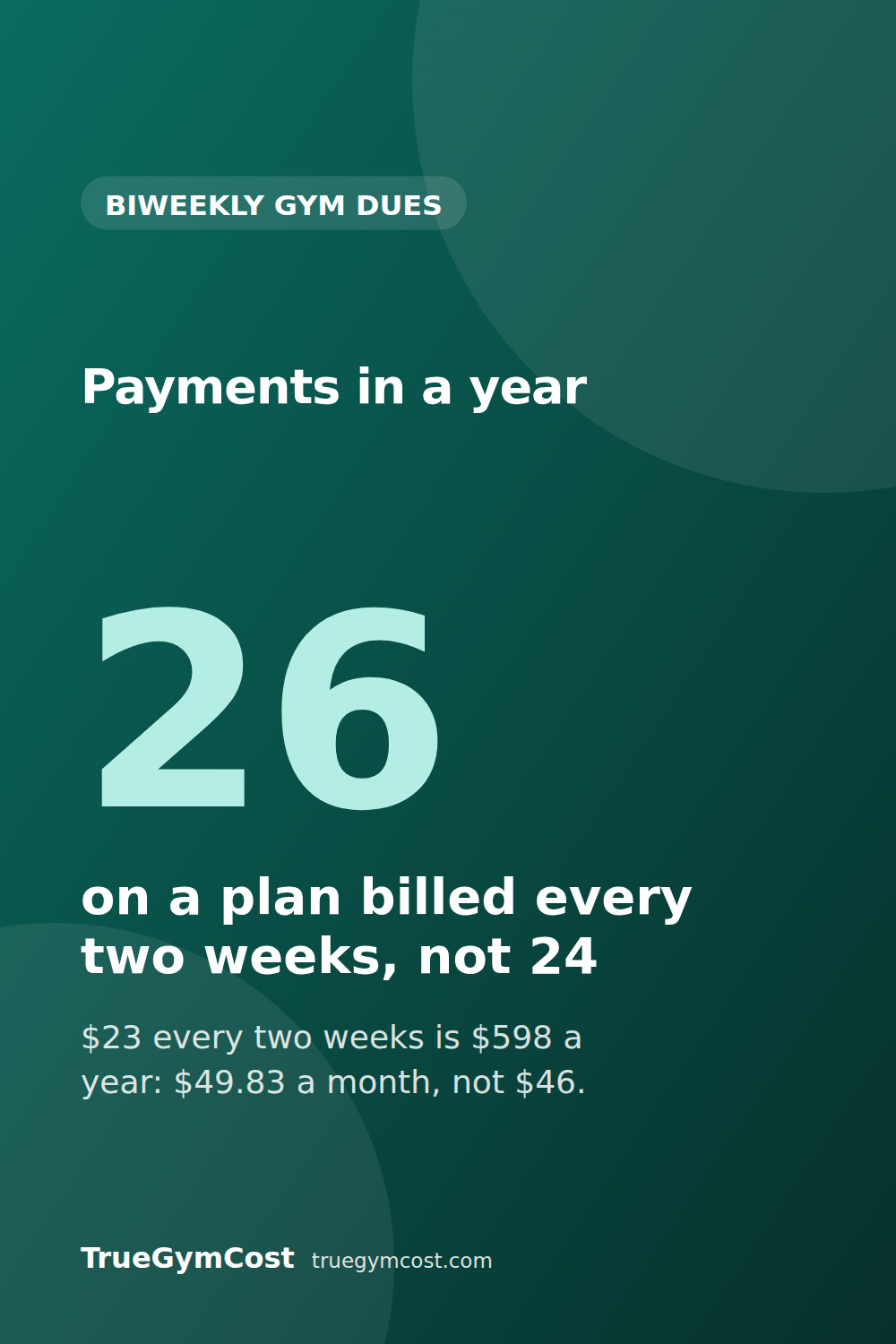
Anytime Fitness doesn't publish a reason for billing every two weeks. Each location is independently owned and operated and sets its own plans, and in San Antonio, 15 of the city's 16 clubs bill every two weeks. What matters for your budget is the math: every two weeks means 26 payments a year, not 24. So $23 every two weeks is $598 a year, which works out to $49.83 a month, not the $46 that "twice a month" suggests.
As of November 3, 2026, the San Antonio clubs charge $17.99 to $32.99 a payment, which is $38.98 to $71.48 a month once 26 payments are spread over 12 months. Two months a year, a third payment comes out, so a monthly budget needs room for it.
Is Anytime Fitness biweekly or monthly?
Mostly biweekly, at least in San Antonio. Of the 16 Anytime Fitness clubs there, 15 charge every two weeks, from $17.99 to $32.99 a payment on each club's cheapest plan. One, the Castle Hills club on West Ave, lists $48 a month instead.
Because each club is its own business, the plans differ even between clubs a few miles apart: a 12-month plan at one, an 18- or 24-month plan at another, month-to-month at a third. The price you see in an ad or on another club's page may not be your club's.
It isn't only Anytime Fitness. Of the 152 San Antonio gyms with a published plan in TrueGymCost's data, 23 bill every two weeks: the 15 Anytime Fitness clubs and all 8 TruFit clubs. Everything else bills by the month.
What does biweekly mean for a gym membership?
Biweekly means every two weeks, on the same day of the week, every 14 days. It doesn't mean twice a month.
The difference is small per payment but adds up. A year has 52 weeks, so a plan billed every two weeks takes 26 payments. A plan billed twice a month would take 24. Those two extra payments are why you can't double the biweekly price to get the monthly one.
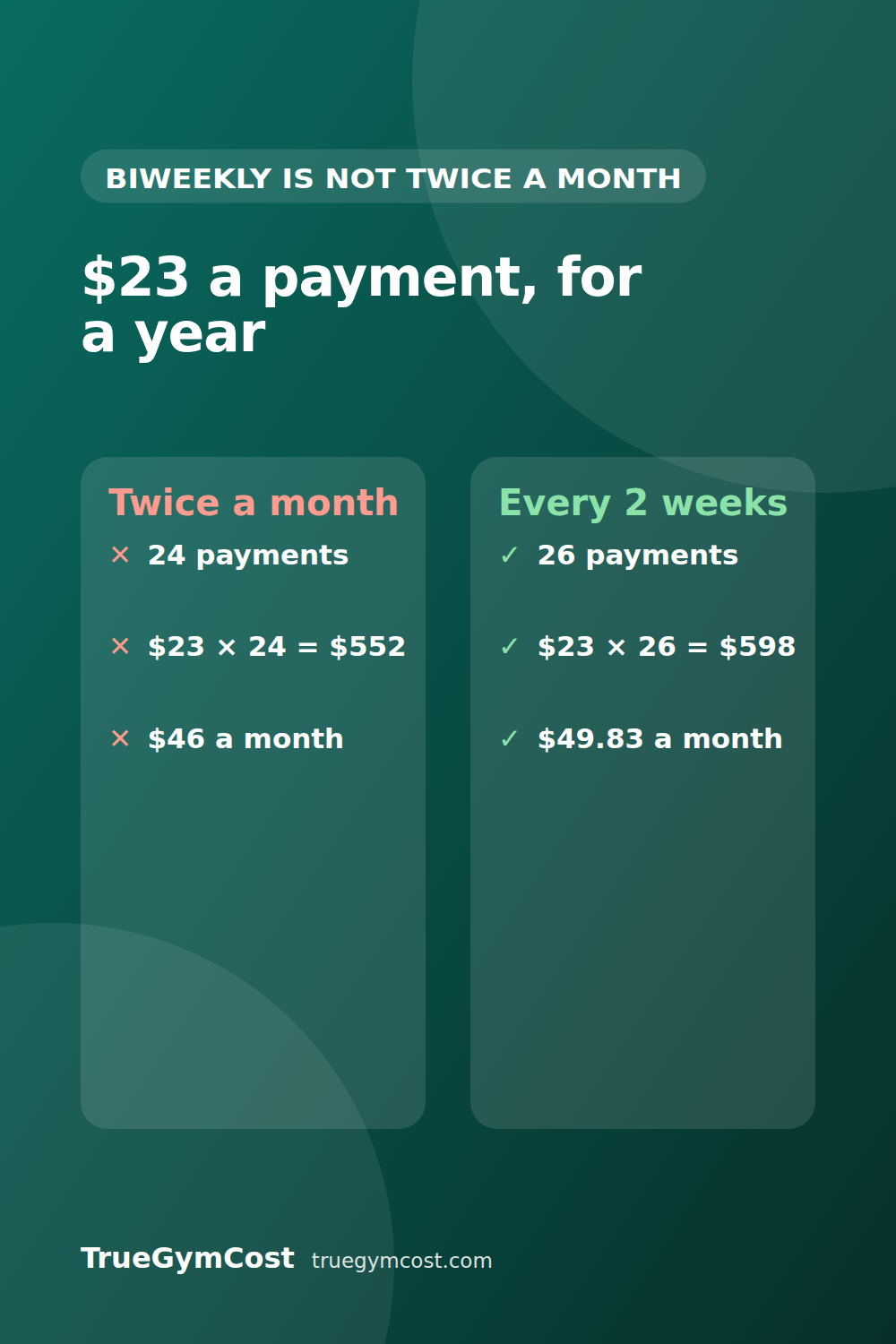
To turn a biweekly price into a true monthly one, multiply by 26 and divide by 12. That's the same as multiplying by about 2.17. On $23, that's $49.83 a month, and $46 more over a year than doubling would tell you.
Why does Anytime Fitness do biweekly payments?
The chain doesn't give a reason. Every location is independently owned and operated, so the schedule, the contract length and the fees are set club by club, and most San Antonio clubs bill every two weeks.
What's certain is what it does to the price you see. A biweekly price is a bit less than half the true monthly one, so it looks smaller next to a gym that quotes by the month. $19.99 every two weeks sounds like half of $39.99 a month. It's really $43.31 a month.
None of that makes a biweekly gym a bad deal. It just means you have to convert before you compare.
How much is Anytime Fitness biweekly, as a monthly price?
Here are eight of the 16 San Antonio clubs, from the cheapest to the dearest, on each club's cheapest plan. The first year adds up 26 payments, the joining fee and any required fee the club publishes, and the annual fee. None of these clubs publishes an annual fee, so each first year is "at least" that much.
| Club | Every 2 weeks | A month | First year |
|---|---|---|---|
| Tezel Rd (12-month) | $17.99 | $38.98 | at least $507.74 |
| Thousand Oaks Dr (12-month) | $19.99 | $43.31 | at least $520.74 |
| Alamo Pkwy (24-month) | $19.99 | $43.31 | at least $540.73 |
| Huebner Rd, 78240 (24-month) | $23 | $49.83 | at least $599 |
| UTSA Blvd (24-month) | $25 | $54.17 | at least $651 |
| Potranco Rd (18-month) | $29 | $62.83 | at least $755 |
| TPC Pkwy (12-month) | $32.99 | $71.48 | at least $907.74 |
| Castle Hills, West Ave | Billed monthly | $48 | at least $576 |
The fees on top differ too. Tezel Rd charges a $40 joining fee, TPC Pkwy a $25 joining fee plus a $25 security activation fee, and Alamo Pkwy a $1 joining fee plus a $19.99 security activation fee. Most of the others advertise joining for $1, then the biweekly dues after it.
Watch the contract length as well. Huebner Rd's cheapest plan is a 24-month plan, so the first year is at least $599, but the whole agreement is 52 payments of $23 plus the $1 to join: $1,197 over two years. The same club's 12-month plan is $27 every two weeks, at least $703 for its year.
The same math at TruFit
TruFit, the other chain that bills every two weeks in San Antonio, works the same way. All 8 of its clubs list the same three plans, each with $1 to join and no annual fee published (as of November 1, 2026):
- Basic: $6.50 every two weeks, which is $14.08 a month and at least $170 for the first year.
- Essentials: $13 every two weeks, $28.17 a month, at least $339.
- Results+: $18 every two weeks, $39 a month, at least $469.
Doubling would have told you $13, $26 and $36 a month. The gaps are small on a cheap plan, but they're the same two extra payments every year.
The months with three payments
Twenty-six payments don't split evenly into 12 months. Most months have two, and two months a year have three. Which two depends on your billing day.
Say your dues come out on Friday, January 8, 2027, and every 14 days after that. April and October 2027 would each see three payments, on the 2nd, 16th and 30th of April and the 1st, 15th and 29th of October. On a $23 plan, that's $69 those months instead of $46.

If you budget by the month, mark those two months once you know your billing day. Your first payment's date tells you the rest: just keep adding 14 days.
Comparing a biweekly gym with a monthly one
Convert, then add the fees. Take two real San Antonio plans, as of early November 2026:
- Anytime Fitness, Thousand Oaks Dr, 12-month plan: $19.99 every two weeks, $1 to join, no annual fee published. That's $519.74 in dues, so at least $520.74 for the first year, or $43.40 a month.
- Gold's Gym, Crossroads Blvd, month-to-month: $39.99 a month, no joining fee, a $59.99 annual fee. That's $479.88 in dues and $539.87 for the first year, $44.99 a month.
On dues alone, the biweekly plan costs $39.86 more a year, even though $19.99 looks like exactly half of $39.99. Add the fees and the monthly gym's annual fee flips it, so its first year comes out $19.13 higher. The Anytime Fitness total is only "at least", though, because the club doesn't publish an annual fee, and its plan is a 12-month contract while the Gold's plan is month-to-month.
The per-payment price tells you very little until you've turned it into a year and added every fee. TrueGymCost's true cost guide goes through the fees gyms add, and why gyms charge an annual fee covers the one that's easiest to miss.
Once you have the first year, divide it by the visits you'll really make. On Huebner Rd's 24-month plan, at least $599 for the year, going once a week makes each visit at least $11.52. Three times a week brings it down to at least $3.84 a visit.
What to ask before you sign
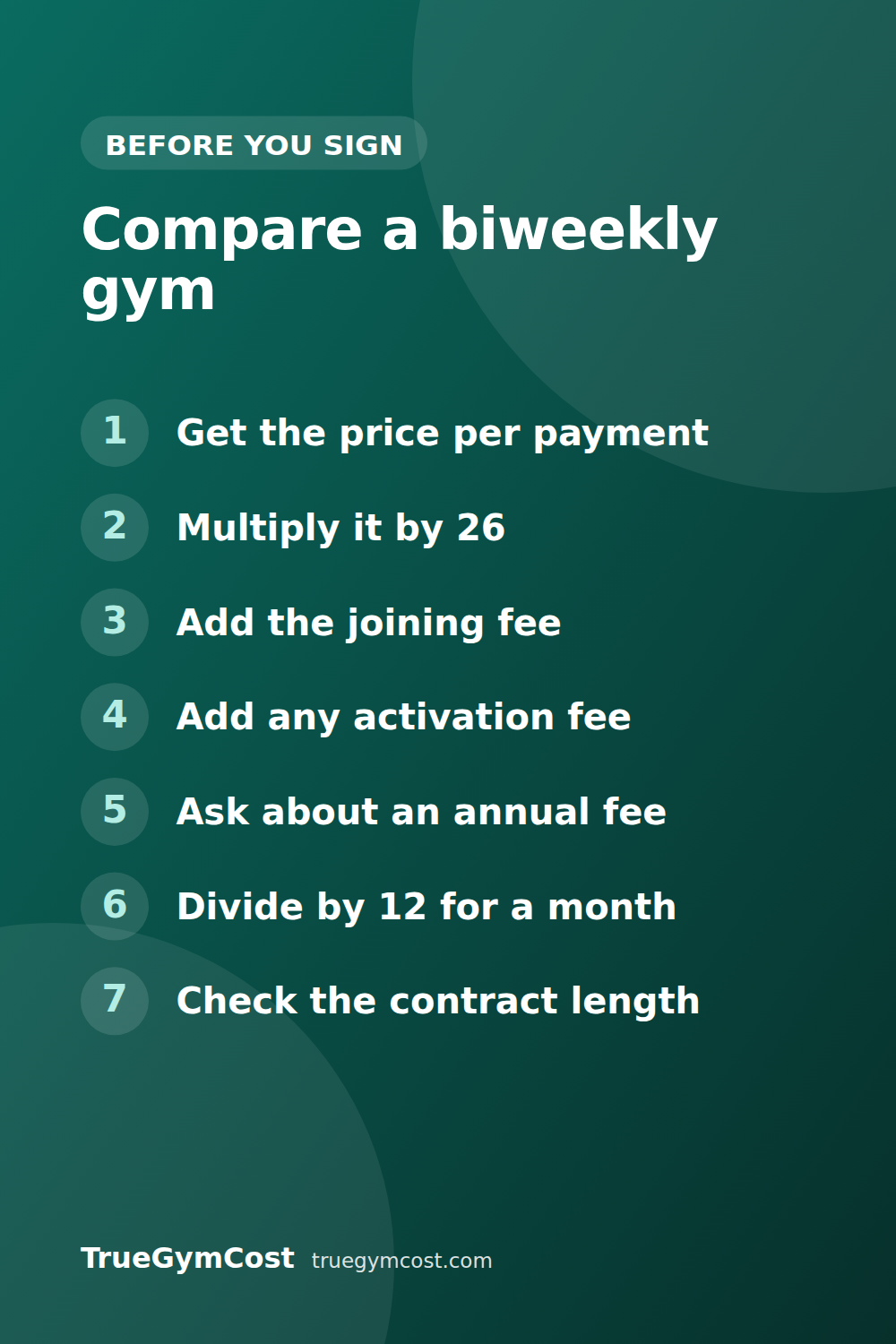
- Ask for the price per payment and how often it's taken. Every two weeks, or monthly?
- Ask about every fee on top: joining, activation or security fees, and whether there's an annual fee. None of the 16 San Antonio clubs publishes one, so ask in person.
- Ask how long the contract is. A 24-month plan can have the lowest dues and the biggest total commitment.
- Ask what it costs to cancel. The clubs' own pages don't state their cancellation fee or notice period, so get it in writing. TrueGymCost's guides to contract red flags and cancelling a gym membership list what to look for.
- Then run the sum: the price × 26, plus the fees, for the first year.
Do that for each gym you're weighing, biweekly or monthly, and you're comparing the same thing at last: what a year really costs.
Questions people ask
Why does Anytime Fitness do biweekly payments?
Anytime Fitness doesn't publish a reason. Each location is independently owned and operated and sets its own plans, and most San Antonio clubs bill every two weeks. The effect is 26 payments a year, so the biweekly price is a little less than half the true monthly cost.
What does biweekly mean for gym membership?
It means a payment every two weeks, every 14 days, which is 26 payments a year rather than the 24 of twice a month. To get a monthly price, multiply the biweekly price by 26 and divide by 12: $23 every two weeks is $49.83 a month.
What are the cons of Anytime Fitness?
On cost, in San Antonio: most clubs bill every two weeks, so the price per payment understates the month; prices and fees vary club by club; and the clubs' own pages don't publish an annual fee or what cancelling costs. Ask about both before you sign.
Sources
- Gym membership: each location independently owned and operated (Anytime Fitness, read 2026-11-10)
- Anytime Fitness Tezel Rd: plans and fees (the club's join page, checked 2026-11-03)
- Anytime Fitness Thousand Oaks Dr: plans and fees (the club's join page, checked 2026-11-03)
- Anytime Fitness Huebner Rd: plans and fees (the club's join page, checked 2026-11-03)
- Anytime Fitness TPC Pkwy: plans and fees (the club's join page, checked 2026-11-03)
- Gold's Gym Crossroads: membership plans (the gym's join page, checked 2026-11-01)
- Anytime Fitness prices in San Antonio, club by club (TrueGymCost, read 2026-11-10)
Keep reading
Why Do Gyms Charge an Annual Fee? When It's Billed and What It Adds
Why do gyms charge an annual fee? It keeps part of the year's price out of the monthly one. Six chains' fees, the day each bills it, and what it adds.
Can a Gym Send You to Collections? What an Unpaid Contract Really Adds Up To
Can a gym send you to collections? Yes, if you signed and stopped paying. What an unpaid contract adds up to, how it hits your credit, and what to do next.
Anytime Fitness Key Fob Fee: What 16 San Antonio Clubs Charge to Let You In
Anytime Fitness key fob fee: join pages call it Security Activation, from $0 to $99 at San Antonio's 16 clubs. What it adds to a year, and a lost fob.